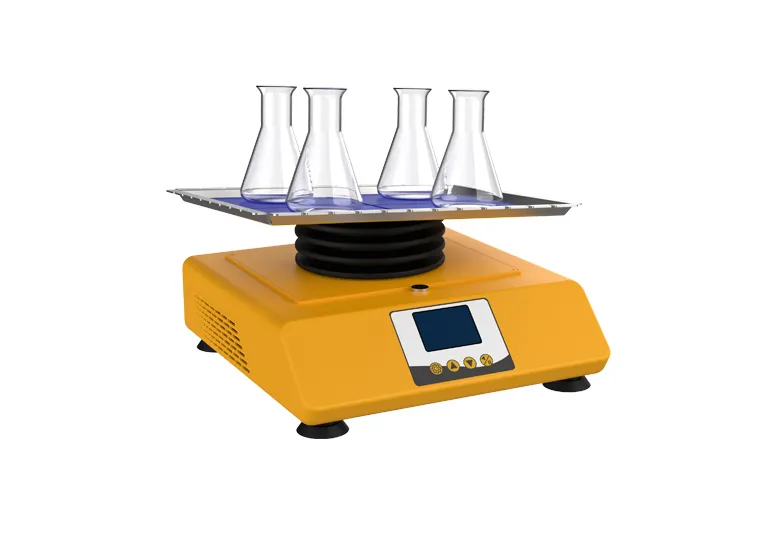
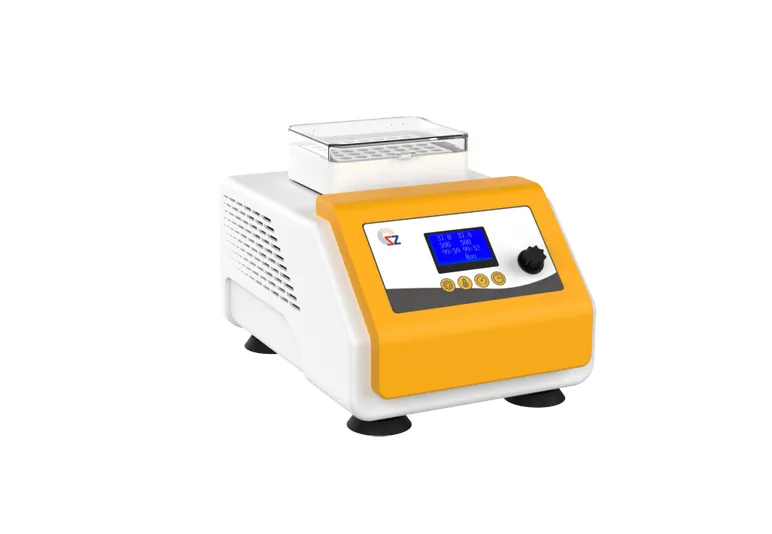
In 2026, R&D pipelines are generating more parallel runs, more plates, and more shake-flask cultures than most labs were designed to handle — yet floor space remains fixed. The result is a familiar and frustrating constraint: every new project that requires more incubation and shaking capacity forces a choice between scheduling conflicts, crowded benches, and the cost and disruption of lab expansion.
For teams running high-throughput cell culture, microbial screening, or process development workflows, the answer is increasingly vertical. Stackable incubator shaker systems convert the unused space above the bench into productive capacity — without adding to the lab footprint. But not all stackable designs deliver the same operational value. When evaluating incubator shaker suppliers, the critical questions are whether each layer operates independently, whether the motion system maintains stability under load across all layers, and whether the platform can scale from two layers today to three layers when throughput demands increase.
This article covers the engineering behind triple-stacked incubator shakers, the specifications that determine real-world performance, the application scenarios where vertical stacking delivers the fastest return, and the selection and maintenance framework for getting the configuration right.
Stackable Incubator Shaker Design: How Triple-Stacking Unlocks Lab Space Optimization
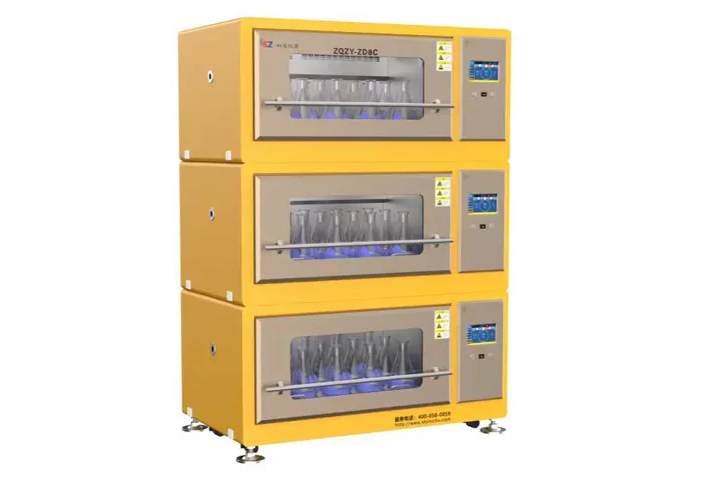
The core problem that a stackable incubator shaker solves is straightforward: you need more shaking and incubation capacity, but your lab footprint cannot expand. The conventional response — purchasing additional floor-standing units — consumes space that most labs do not have, creates traffic flow problems around critical benches, and multiplies the number of platforms that need to be maintained, calibrated, and managed under different SOPs.
Triple-stacking changes the geometry of that problem. Instead of three separate floor-standing units occupying three separate footprints, a triple-stacked system concentrates the capacity of three independent shaking incubators into the footprint of one. The vertical dimension — typically underutilized in most lab layouts — becomes the expansion axis.
The operational impact goes beyond the space saving itself. Consolidating capacity into a single platform family simplifies SOP standardization: the same vessel fixtures, the same control interface, and the same maintenance procedures apply across all three layers. Scheduling becomes easier when all capacity is in one location rather than distributed across multiple units in different parts of the lab. And the cleaner traffic flow around a single consolidated unit reduces the handling friction that accumulates across a high-throughput workday.
For labs that are not yet at three-layer capacity, modular stacking architecture allows a two-layer configuration to be deployed now and expanded to three layers later — without replacing the existing units. This protects the initial capital investment and allows capacity to scale with actual demand rather than anticipated demand.
Triple-Layer Independence: The 2026 Requirement for High-Throughput Cell Culture
Stacking three incubator shakers vertically only delivers full throughput value if each layer operates independently. In high-throughput cell culture and screening environments, parallel runs rarely share the same protocol. A team running a temperature-sensitive mammalian cell culture on one layer, a microbial fermentation at a different temperature and speed on the second layer, and a stability hold at a third condition on the third layer needs each layer to maintain its own setpoints without interference from the others.
This independence requirement has two dimensions: thermal independence and motion independence.
Thermal independence means that the temperature control system for each layer maintains its setpoint regardless of what the adjacent layers are doing. A layer running at 37°C should not be affected by a layer running at 25°C or 30°C. This requires each layer to have its own heating and cooling system with independent control logic — not a shared thermal management system that averages conditions across the stack.
Motion independence means that each layer's shaking speed, orbit, and timing can be set and adjusted without affecting the other layers. Start and stop times, speed ramps, and duty cycles should be programmable per layer so that different protocols can run simultaneously on their own schedules.
When evaluating incubator shaker suppliers, confirming true layer independence — not just separate control panels that share a common drive or thermal system — is the most important technical question in the procurement process. A system that advertises independent control but shares thermal or mechanical components between layers will not deliver the parallel protocol flexibility that high-throughput workflows require.
Large Capacity Orbital Shaker Performance: Motion Stability, Speed Control, and Repeatability
The incubation environment determines whether cultures survive. The shaking system determines whether they thrive. In high-throughput screening and process development, inconsistent orbital motion — speed variation, vibration, or platform instability under load — produces variable oxygen transfer rates, inconsistent mixing, and growth variability that introduces noise into screening data and increases rerun rates.
Triple-Eccentric Drive Design
Zhichu's stackable incubator shaker use a triple-eccentric drive system to generate smooth, uniform orbital motion across the platform. The triple-eccentric geometry distributes the mechanical forces of orbital motion more evenly than a single-eccentric design, reducing vibration transmission to the platform surface and to the stack structure. The result is more consistent motion at the vessel level — particularly important for larger flasks and heavier loads where a single-eccentric drive may produce perceptible wobble or speed variation.
Servo Motor Control
Speed control precision is delivered through servo motor technology, which provides closed-loop feedback on actual motor speed and adjusts drive output continuously to maintain the setpoint. Compared to open-loop motor control, servo control maintains speed accuracy under varying loads — including the load changes that occur as culture volume shifts during a run or as vessels are added or removed from the platform.
For high-throughput screening applications where speed consistency directly affects oxygen transfer rate and mixing uniformity, servo motor control reduces the run-to-run variability that would otherwise require additional replicates to achieve statistical confidence.
Key Performance Specifications
| Parameter | What to Specify | Why It Matters |
|---|
| Orbit diameter | Match to vessel type and OTR requirement | Larger orbit improves oxygen transfer for baffled flasks; smaller orbit suits microplates |
| Speed range | Confirm minimum and maximum RPM for your protocols | Wide range supports both slow mixing and high-aeration applications |
| Speed accuracy | Deviation from setpoint under load | Directly affects OTR consistency and growth repeatability |
| Platform dimensions | Match to vessel array and clamp/fixture configuration | Determines how many vessels fit per layer |
| Noise level | Relevant for shared lab environments | Servo motor systems typically run quieter than brush motor alternatives |
| Load capacity | Maximum platform load per layer | Must account for vessel weight plus liquid volume plus fixture mass |
From Screening to Pilot: Application Scenarios Where Triple-Stacked Shakers Win
High-Throughput Screening and Strain Selection
Screening programs that evaluate dozens or hundreds of strains, conditions, or formulations in parallel are the highest-value application for triple-stacked incubator shakers. The combination of large per-layer capacity, independent layer control, and stable orbital motion allows multiple screening campaigns to run simultaneously on different layers without scheduling conflicts or protocol compromises. The footprint consolidation is particularly valuable in screening labs where bench space is allocated across multiple projects.
Microbial Fermentation and Media Optimization
Shake-flask fermentation and media optimization workflows involve repeated DOE runs across multiple conditions — temperature, pH, carbon source, inoculum density — that benefit from the ability to run different temperature setpoints simultaneously on different layers. The motion stability of the triple-eccentric drive system ensures consistent oxygen transfer across all positions on the platform, which is critical for fermentation data that will be used to guide bioreactor scale-up decisions.
Process Development and Scale Bridging
Larger-capacity stackable models — with per-layer working volumes in the 282-liter class — support the transition from bench-scale screening to pilot-scale process development within the same platform family. Running scale-bridging experiments on the same shaker platform as the original screening work reduces the equipment-change variables that can complicate scale-up interpretation.
Contamination Control and Unattended Operation
For labs running overnight or weekend cultures without continuous operator presence, contamination control features reduce run losses from undetected events. UV decontamination options, door-open stop functions, and over-temperature alarms allow unattended runs to proceed with appropriate safeguards. These features are particularly valuable in high-throughput environments where a single contamination event can invalidate an entire screening plate or fermentation series.
Installation, Selection, Maintenance, and TCO: Specifying the Right Triple-Stacked Incubator Shaker
Selection Decision Flow
Step 1 — Define throughput target
Establish flasks or plates per day, batch frequency, and peak week demand.
This determines the minimum per-layer capacity and the number of layers needed.

Step 2 — Identify vessel types and fixtures
List all vessel formats used: flask sizes, microplate formats, tube racks.
Confirm that universal clamps or dedicated fixtures are available for each format.
Fixture compatibility determines actual usable capacity per layer.

Step 3 — Confirm temperature requirements
Define setpoint range for each concurrent protocol.
If protocols require different temperatures simultaneously, confirm true
thermal independence between layers.
If cooling below ambient is required, confirm refrigerated model availability.

Step 4 — Plan layer count and expansion path
Determine whether two layers meet current demand with headroom,
or whether three layers are needed immediately.
Confirm that the supplier supports modular expansion from two to three layers
without replacing existing units.

Step 5 — Verify installation constraints
Measure ceiling clearance for the fully stacked height.
Confirm door swing clearance for the top layer — ergonomic access
to the upper layer is a daily usability factor that is easy to overlook
in the procurement process.
Confirm floor load capacity, power supply, and ventilation requirements.
Installation Requirements
Triple-stacked incubator shakers require attention to three installation factors that single-unit systems do not present.
Ceiling clearance must accommodate the full stacked height plus adequate clearance for door opening on the top layer. Confirm this measurement before ordering, including any overhead obstructions such as shelving, HVAC ducts, or lighting fixtures.
Floor load capacity should be verified for the combined weight of all three layers fully loaded with vessels and liquid. Most standard lab floors accommodate this without modification, but older buildings or raised-floor installations may require verification.
Heat rejection from refrigerated models requires adequate ventilation around the condenser. Confirm clearance distances on all sides and ensure that the installation location does not trap heat from adjacent equipment.
Maintenance and TCO
| Maintenance Activity | Frequency | TCO Impact |
|---|
| Drive system inspection | Quarterly | Prevents motion instability that causes reruns |
| Door seal inspection and replacement | Per wear or annually | Maintains temperature uniformity; prevents condensation ingress |
| Refrigeration system check (refrigerated models) | Annually | Confirms cooling capacity and defrost function |
| Defrost scheduling (refrigerated models) | Per protocol | Align defrost windows with non-run periods to protect uptime |
| Temperature uniformity verification | Annually or after maintenance | Confirms setpoint accuracy across platform; supports audit records |
| Platform and clamp cleaning | Per protocol | Prevents cross-contamination between runs |
The most useful TCO metric for a triple-stacked incubator shaker is cost per successful run — the total of equipment depreciation, energy, labor, and consumables divided by the number of runs that produce valid, usable data. Reducing the rerun rate through better motion stability and temperature control has a larger impact on this metric than the purchase price difference between equipment tiers.
 English
 日本語
日本語 한국어
한국어 français
 Deutsch
 Español
 русский
 português
 العربية
 ไทย
ไทย tiếng việt