Working Principle of Ultrasonic Cell Disruptor
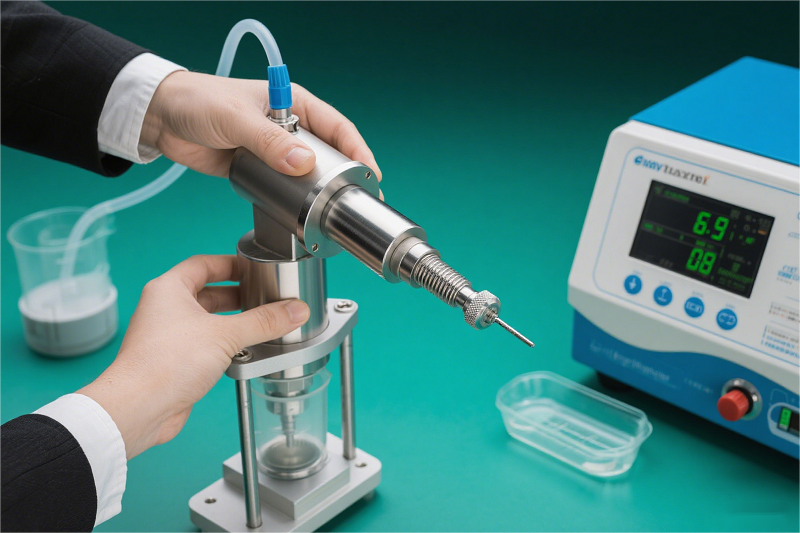
The core principle of the ultrasonic cell disruptor is based on the synergistic effect of cavitation and mechanical vibration. When the high-frequency ultrasound (20-40kHz) generated by the device is converted into mechanical vibrations by the transducer and transmitted to the sample solution, this key working process of the ultrasonic cell crusher induces a series of physical and chemical reactions:
Formation and Collapse of Cavitation Bubbles: Microbubbles in the liquid rapidly expand under the action of the negative pressure phase of sound waves and then collapse instantly under the positive pressure phase, generating high pressure and shock waves that destroy the cell membrane structure.
Mechanical Shear and Friction: High-frequency vibrations cause the liquid molecules to move vigorously, forming strong shear forces and turbulence that further tear cell tissues apart and accelerate the release and mixing of intracellular substances.
Heat Effect Assistance: The minute heat generated during the energy conversion process can aid in breaking the hydrogen bonds and hydrophobic interactions within cells, enhancing the disruptive effect.
This dual action of "explosion + shear" allows the ultrasonic cell disruptor to efficiently break various samples in a short period, causing minimal damage to the activity of the target product.
Technical Advantages of Ultrasonic Cell Disruptor
High Disruption Efficiency
Compared to traditional methods such as high-pressure homogenization and grinding, the ultrasonic cell disruptor has higher disruption efficiency. For example, breaking a 10mL yeast cell suspension takes only 8 minutes with the ultrasonic method, whereas the grinding method takes 40 minutes. The ultrasonic cell crusher is especially suitable for the rapid processing of small batch samples, usually completing the disruption within 10-30 minutes.
Wide Sample Applicability
The ultrasonic cell disruptor can handle various types of samples, from bacteria (such as E. coli) to animal tissues (such as liver and tumors). By adjusting the power and time, it can be used for gentle disruption (e.g., preserving the structure of organelles) or thorough lysis (e.g., releasing intracellular enzymes).
Intelligent Operation
Modern ultrasonic cell disruptors are generally equipped with touch screen control systems that support one-click start, parameter memory, and fault self-diagnosis functions. Some models can automatically recommend the optimal power and time based on the sample volume, allowing novice researchers to quickly get started.
Low Energy Consumption and Low Pollution
Compared to technologies such as microwave disruption, the ultrasonic cell disruptor reduces energy consumption by more than 30%. It does not require the use of chemical reagents (such as lysozymes), avoiding contamination of the samples with foreign substances, making it particularly suitable for the extraction of high-purity substances.
Development Trends of Ultrasonic Cell Disruptor
Intelligent and Automated Upgrading
In the future, devices will integrate AI algorithms to optimize disruption parameters through machine learning, achieving "unmanned" intelligent disruption. The application of IoT technology will support remote monitoring of equipment operation status and real-time adjustment of experimental parameters.
Expansion of Large-Scale Industrial Applications
Industrial-grade ultrasonic cell disruptors (processing capacity >1000L/h) are becoming a research hotspot. New equipment will adopt multi-probe array design and continuous flow disruption technology, solving the low efficiency problem of traditional batch processing, and is suitable for large-scale production scenarios such as biopharmaceuticals and food processing.
Integration of Green Technologies
Developing high-frequency low-power disruption modes to achieve completely enzyme-free and reagent-free green disruption. Designing a transducer waste heat recovery device to convert the heat generated during disruption into electrical energy or to heat other systems, reducing the overall energy consumption of the equipment.
Innovation in Multi-Technology Integration
The ultrasonic cell disruptor will combine with microfluidic technology and cryogenic disruption to develop multifunctional composite equipment. Conducting ultrasonic disruption in a low-temperature environment can achieve both cell lysis and low-temperature protection of target proteins, improving the yield of active substances.
 English
 日本語
日本語 한국어
한국어 français
 Deutsch
 Español
 русский
 português
 العربية
 ไทย
ไทย tiếng việt